
Fashion is one of the most volatile forms of art and therefore particularly prone to change in retrospective interpretation. To fully comprehend the genius of a 19th century Parisian designer, one has to understand way more than apparel construction, textile composition or color theory. One has to be in sync with the social movements of the period, political context and so much more. Ultimately all these seemingly unrelated trends and events are transposed into unique designs that capture the soul of the époque like no other medium of expression.
Yet, like many other fashion enthusiasts, I often find myself fully emerged in the beauty of a unique garment manufactured two centuries ago. The acute sense of spiritual and material realm is a double edge sword. On one hand it allows us to acknowledge with certainty that fashion is art and, on the other hand it is a reminder that our perception of art is severely delimited by the sometimes flawed understanding of its context.
While diving into the fashionable past might be a challenging (although still rewarding) experience, we are never more entitled to an opinion like we are when assessing the work of contemporary fashion designers. As active cast of the modern times we have the right, the expertise and even liability to judge the accuracy of the social reflection and (why not?) to decide upon the unique elements (albeit toned down) that can eventually become part of our personal wardrobe.
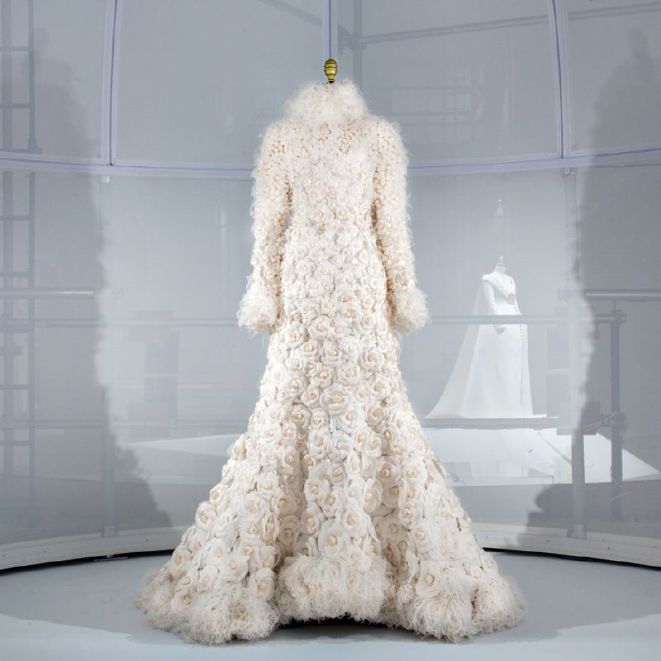
The Metropolitan Museum of Art is currently hosting the exhibition called Art Manus x Machina: Fashion in an Age of Technology and offers us the opportunity to get in touch with multiple facets of the present and not so distant past though the unique perspective of designers around the world. True to its name the exhibition offers a wide range of styles that are constructed using a combination of new and traditional techniques including 3D printing, hand painting, manual and machine embroideries to name a few.
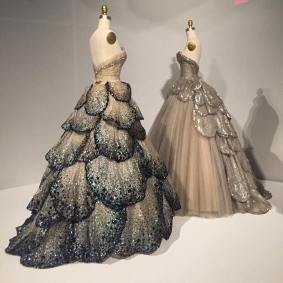
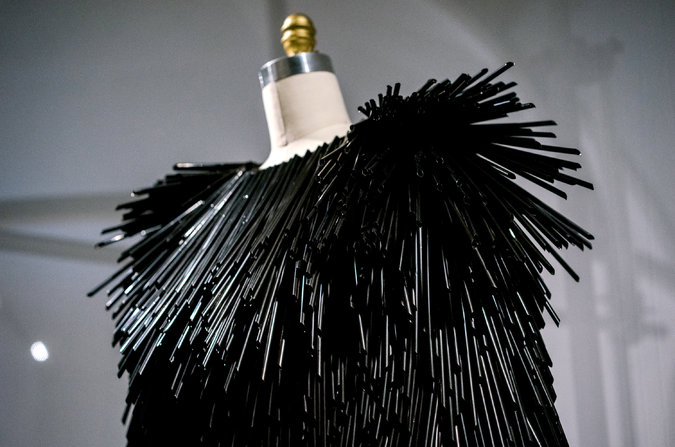
While similar in terms of execution excellence the designs are taking us on a fashion roller-coaster moving from feminine simplicity to romanticism to avant-garde, all in a blink of an eye. Here you will be able to find colorful Dior sun dresses and classic Chanel gowns in close proximity to futuristic, straw like creations by British Designer Gareth Pugh that are reminiscent of fur materials. And speaking of fur, I was particularly impressed to find no designs that would incorporate that material. I believe that to be a reflection of where the fashion industry is heading to. A mere suggestion that design should be bounded by social responsibility, scarcity and feelings of compassion, while genuine creativity will always look for and find a new form of expression.
One might sometimes fail to understand the revolutionary patterns, or seemingly twisted 3D printed dresses that are part of the exhibition. In moments like that it becomes easy to label things as too daring or out of touch with reality… yet it’s also the right time to pause for a second and dare to enter the world of haut-couture with an open mind, fully devoid of the practical prejudice. It is the right time to remind ourselves that fashion has one of the most effortless feedback loops, where shape and color is not only a reflection of the day but sometimes a reinforcing power that can define the content. Eventually, if we are brave enough, we might be able to recognize a somewhat familiar face in the colorful metaphors.
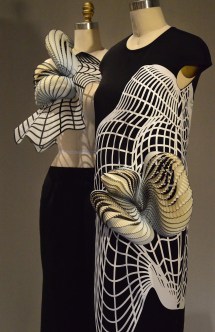
I was particularly impressed with the work of Israeli designer Noa Raviv, whose monochrome work captures a unique combination of clean cuts and 3D printed elements. The spiderweb patterns, have a double effect of creating visual depth in the black textile and offering a organic transition into the 3D ornaments. The result is both futuristic and conservative, allowing us to see a sharp and complex femininity that becomes almost unavoidable in the light of our technology driven world. In my view, the dress captures the optimized human transactions in modern times overplayed by the lurking complexities of digital interactions that bloom and flourish in ways we never deemed possible.
I encourage all New Yorkers and visitors of NY to see the fashion exhibition at THE MET – it’s open until Spetember 5, 2016.


 Retail Therapy